
Study Tips
How to Understand the Basics of Differentiation
By Sana Iqbal · · 4 min read
Quick answer
Differentiation finds the rate at which one quantity changes with another — the gradient of a curve at a point. The basic rule for powers is quick to learn once you know it. Understanding differentiation as finding a gradient, and what that gradient means, matters more than the notation, which looks harder than it is.
What differentiation finds
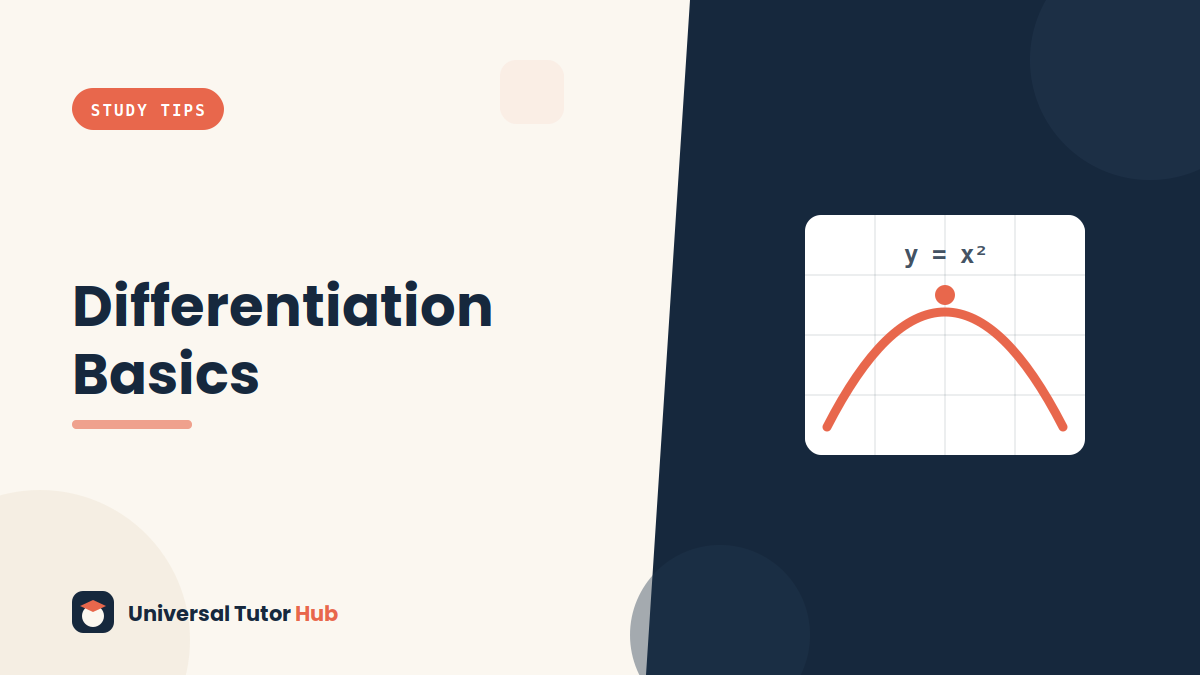
Differentiation finds how quickly one quantity changes with respect to another — in graph terms, the gradient of a curve at any point. Where a straight line has one gradient, a curve's gradient changes, and differentiation tracks it.
Grasping this meaning — the changing steepness of a curve — is more important than the notation, and it makes the whole topic purposeful rather than abstract.
The gradient at a point
On a curve, the gradient is different at every point. Differentiation gives a formula for the gradient at any point, so you can find how steep the curve is wherever you like.
This is the core idea. Once you see differentiation as producing a gradient formula, its uses — finding maximums, rates of change — follow naturally.
The basic power rule
For powers, the basic rule is quick: multiply by the power, then reduce the power by one. This single rule handles a large share of introductory differentiation.
Learning this rule and practising it until it is automatic gives you the main tool. Most early differentiation is applying it carefully.
Don't fear the notation
Differentiation notation looks intimidating, but it is just a way of writing 'the rate of change of this with respect to that'. Reading the notation as its meaning demystifies it.
Students often freeze at the symbols. Translating them into plain meaning — the gradient, the rate of change — removes much of the fear.
What the gradient tells you
The gradient at a point has meaning: where it is zero, the curve is momentarily flat, which is how you find maximum and minimum points. A positive gradient means rising, negative means falling.
Connecting the gradient to what the curve is doing, and to real quantities like speed, is what makes differentiation genuinely useful rather than mechanical.
Build from the basics
Introductory differentiation rests on understanding the gradient idea and the power rule. Securing these makes the later techniques, which build on them, far more approachable.
Rushing past the basic meaning to memorise rules leaves students lost later. Understanding what differentiation does, from the start, pays off throughout the topic.
Frequently asked questions
What does differentiation do?+
It finds how quickly one quantity changes with respect to another — the gradient of a curve at any point. Where a straight line has one gradient, a curve's gradient changes, and differentiation tracks it.
What is the basic rule for differentiation?+
For powers, multiply by the power and reduce the power by one. This single rule handles a large share of introductory differentiation, so learning it until it is automatic gives you the main tool.
Why does the notation look so hard?+
It looks intimidating but just means 'the rate of change of this with respect to that'. Reading the notation as its plain meaning — the gradient — demystifies it and removes much of the fear.
What does the gradient tell me?+
Where it is zero, the curve is momentarily flat, which is how you find maximum and minimum points. A positive gradient means rising, negative means falling — connecting it to what the curve is doing.
How do I get started with differentiation?+
Understand the gradient idea and the power rule first. Securing these basics makes the later techniques, which build on them, far more approachable, whereas rushing past the meaning leaves you lost later.
Try your first session free
Meet your tutor, set your goals, and see the difference one-to-one attention makes. No card required, no commitment.