
Study Tips
How to Understand Functions in Mathematics
By Sana Iqbal · · 4 min read
Quick answer
A function is a rule that takes an input and gives exactly one output. Thinking of it as a machine — put a number in, get a number out — makes the idea and its notation clear. Functions run through algebra, graphs and calculus, so understanding them well supports much of mathematics.
A function is a rule
A function is a rule that takes an input and produces exactly one output. Give it a number, and it returns a specific result according to its rule. That 'exactly one output' is part of the definition.
This simple idea — a rule turning inputs into outputs — underlies a great deal of mathematics, so understanding it clearly pays off widely.
The machine picture
A helpful way to picture a function is as a machine: you put a value in, the machine processes it by its rule, and a value comes out. Different inputs give different outputs, following the same rule.
This machine image demystifies functions and their notation, turning an abstract idea into something concrete you can reason about.
The notation
Function notation, like writing the function of an input, simply names the rule and shows what it does to the input. It looks abstract but just says 'apply this rule to this input'.
Reading the notation as its meaning — apply the rule to what is inside — removes the confusion many students feel when they first meet it.
Inputs, outputs and their sets
A function has a set of allowed inputs and the outputs they produce. Knowing which inputs are allowed, and what outputs result, is part of understanding a function fully.
For some functions, certain inputs are not allowed, and recognising these is part of working with functions correctly.
Functions and graphs
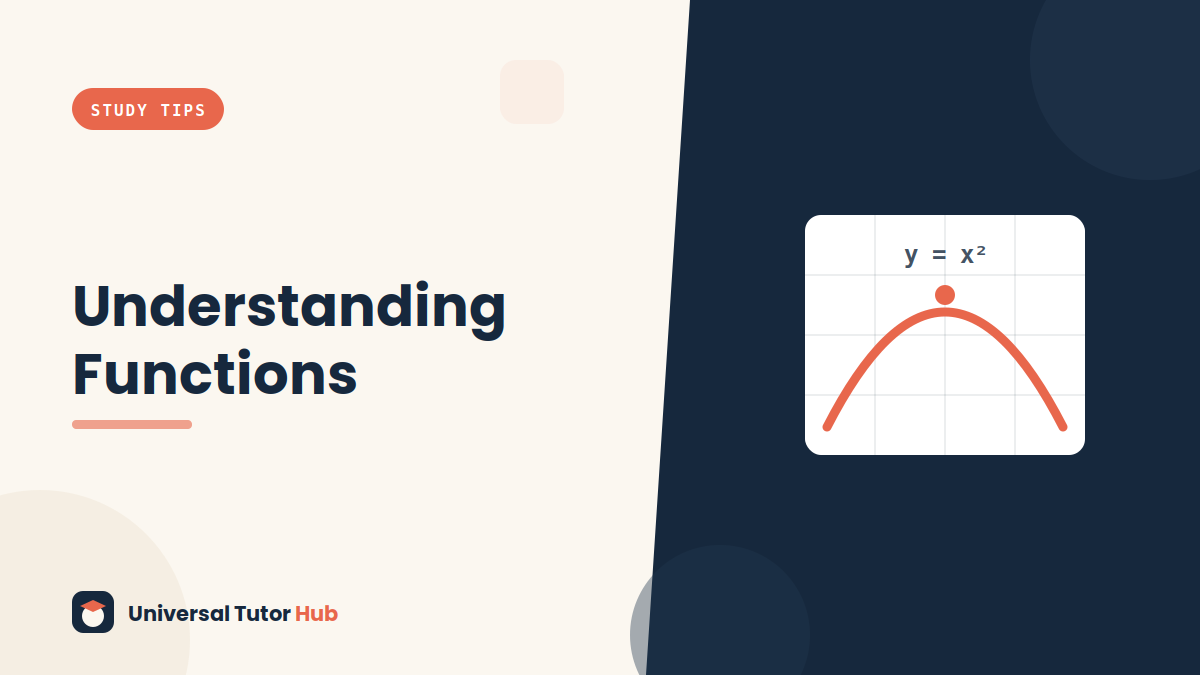
A function can be drawn as a graph, showing every input with its output. The graph is a picture of the function's behaviour, and reading it connects the algebra to a visual understanding.
Seeing a function both as a rule and as a graph gives two complementary views, each illuminating what the other cannot.
Why functions matter
Functions run through algebra, graphs, calculus and beyond. So many topics are really about functions that understanding them well makes much of later mathematics more approachable.
Treating functions as a foundation to master, rather than one topic among many, sets you up for the many areas that build on them.
Frequently asked questions
What is a function in maths?+
A rule that takes an input and gives exactly one output. Give it a number and it returns a specific result according to its rule. That 'exactly one output' is part of the definition.
What's a good way to think about functions?+
As a machine: you put a value in, it processes it by its rule, and a value comes out. This machine image demystifies functions and their notation, making an abstract idea concrete.
Why is function notation confusing?+
It looks abstract but simply names the rule and shows what it does to the input — 'apply this rule to this input'. Reading the notation as its meaning removes the confusion many students feel.
How do functions relate to graphs?+
A function can be drawn as a graph showing every input with its output — a picture of its behaviour. Seeing a function both as a rule and a graph gives two complementary views.
Why are functions so important?+
Because they run through algebra, graphs, calculus and beyond — so many topics are really about functions that understanding them well makes much of later mathematics far more approachable.
Try your first session free
Meet your tutor, set your goals, and see the difference one-to-one attention makes. No card required, no commitment.