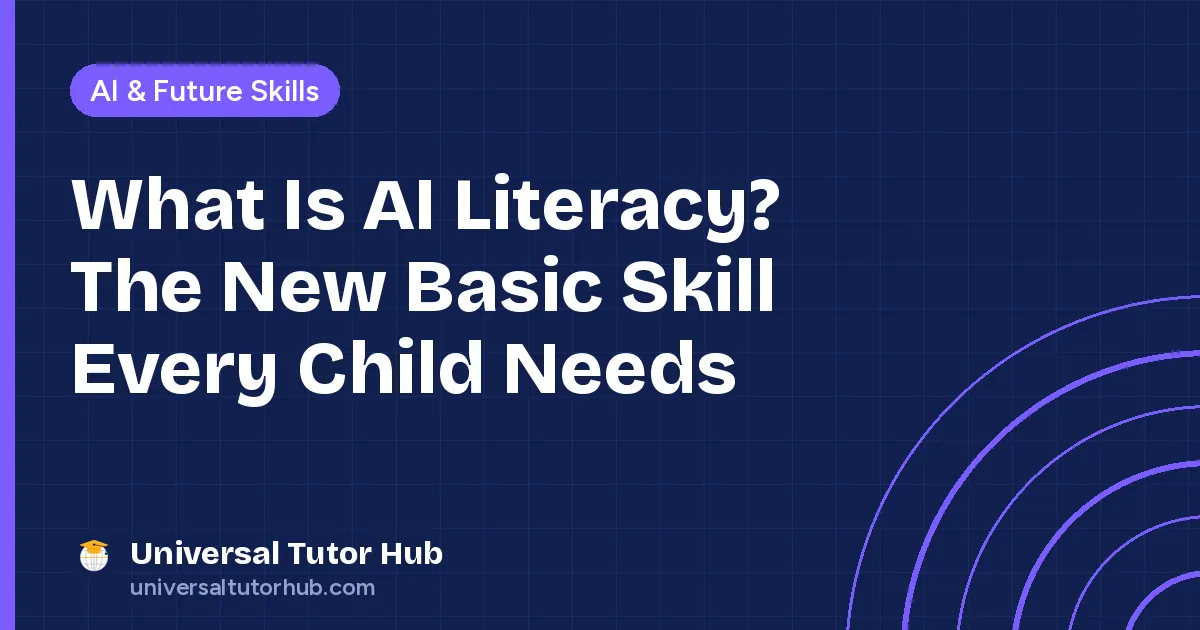
AI literacy is the ability to understand what AI is and how it works at a basic level, use AI tools effectively, question and verify their output, recognise risks such as bias, privacy and deepfakes, and use AI ethically. Like reading and digital literacy, it is becoming a basic skill for every student.
A new kind of literacy
Literacy once meant reading and writing. Then digital literacy was added: using computers, searching the web and staying safe online. AI literacy is the next layer. Children now encounter AI in search results, homework apps, social media feeds, games and voice assistants. Understanding it is no longer optional.
The five parts of AI literacy
1. Understanding
Knowing, in simple terms, that AI learns patterns from data, that it predicts rather than "knows", and that it can be wrong. Children do not need technical detail, but they need the right mental model.
2. Using
Being able to use AI tools effectively: writing clear prompts, asking follow-up questions and choosing the right tool for the task.
3. Evaluating
Questioning AI output: Is this true? How do I check? Is this image real? Who made this and why? This is perhaps the most important protective skill.
4. Acting responsibly
Understanding privacy (what not to share), honesty (when AI help is allowed in schoolwork), fairness (how bias appears) and respect (not using AI to harm or deceive others).
5. Creating
Using AI to make things: stories, art, games, tools and solutions. Creating builds confidence and turns children from passive consumers into active makers.
Why it matters now
- Misinformation: AI-generated images, audio and video make fake content easier to produce. See how to spot deepfakes.
- Learning: students who use AI well learn faster; those who use it badly learn less.
- Future work: almost every career will involve AI tools.
- Safety: children who understand AI are better at recognising manipulation and scams.
AI literacy by age
| Age | Focus |
|---|---|
| 7 to 9 | AI is a tool made by people; it can make mistakes; never share personal details |
| 10 to 12 | How AI learns from examples; checking answers; creative projects; spotting fakes |
| 13 to 15 | Prompting; honest use in schoolwork; bias; privacy; building simple tools |
| 16 and above | AI in careers; building apps and automations; ethics and regulation |
How parents can build AI literacy at home
- Explore an AI tool with your child and talk about its answers.
- Play "catch the mistake": ask questions you know the answers to.
- Discuss a news story about AI together.
- Agree family rules on AI and homework.
- Encourage creating over consuming.
Structured learning
Our AI for Kids course (ages 8 to 13) and AI for Teens course build all five parts of AI literacy through live, supervised projects. See also our guide for parents.
Frequently asked questions
Is AI literacy taught in schools?
Increasingly, in some countries and schools, but coverage is uneven, and many school systems have not yet added it. Families often need to fill the gap.
Does AI literacy mean my child must learn coding?
No. Coding is helpful but separate. AI literacy is about understanding and responsible use.
Is it safe for young children to use AI?
With supervision and age-appropriate tools, children can learn about AI safely. Many general AI tools have minimum ages in their terms.