Guides
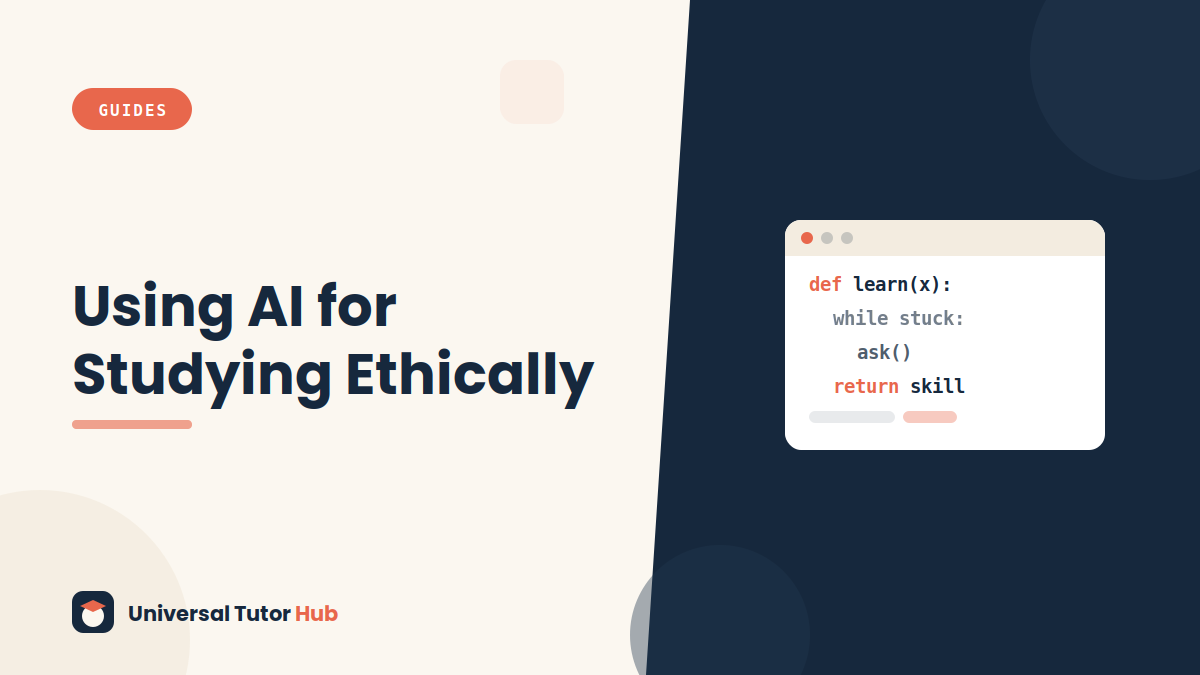
How to Use AI for Studying Without Cheating
By Dr Ayesha Khan · · 4 min read
Quick answer
AI is useful for explaining concepts, generating practice questions and checking your reasoning after you have attempted something. It becomes harmful when it produces work you submit as your own, or when it removes the productive struggle that learning requires. Always check your institution's policy, and verify factual claims independently.
The genuinely useful uses
Asking for an explanation of a concept in different words, generating practice questions, checking your reasoning after you have attempted a problem, and getting feedback on the structure of an essay you wrote are all legitimate and often valuable.
The common thread is that you do the thinking and the tool supports it. Used this way, an AI tool is a patient explainer available at midnight, which is a real benefit.
Where it stops being learning
Having it write your essay, complete your problem set or produce a paragraph you paste in is not learning and is usually academic misconduct. But there is a subtler failure that catches honest students too.
If you ask for the answer before attempting the problem, you skip the productive struggle that actually builds understanding. The result feels efficient and teaches you very little — the same trap as watching worked solutions.
Attempt first, always
Make it a rule: try the problem yourself before asking. Then use the tool to check your reasoning, explain where you went wrong, or offer a different approach.
This sequence preserves the learning and adds the explanation. Reversing it removes both.
Verify what it tells you
AI tools produce fluent, confident text that is sometimes wrong — including invented references, incorrect dates and plausible-sounding but false explanations. Fluency is not accuracy.
Check anything factual against your textbook, your specification or a reliable source. Never cite a reference an AI gave you without confirming it exists.
Know your institution's rules
Policies vary widely between schools and universities and are changing quickly. Some permit AI for brainstorming with declaration; others prohibit it entirely for assessed work.
Check the current policy for your specific course rather than assuming, and when in doubt ask your teacher directly. 'I did not know' is rarely accepted afterwards.
It cannot replace being taught
An AI tool does not know what you already understand, cannot see your face when you are lost, and cannot decide that today's plan should change because of what you got wrong last week.
It is a useful supplement to teaching and a poor substitute for it — particularly for diagnosing why you are stuck, which is usually the hard part.
Frequently asked questions
Is using AI to help with homework cheating?+
It depends on how and on your institution's policy. Using it to explain a concept is generally fine; submitting text it produced as your own work is generally not. Check your school or university's rules directly.
Can teachers tell if I used AI?+
Detection tools exist and are imperfect in both directions. More reliably, teachers notice work that does not match your usual voice or that you cannot explain when asked about it.
How can AI actually help me learn?+
Ask it to explain a concept differently, generate practice questions, or review your reasoning after you have attempted something. Keeping yourself as the one doing the thinking is what makes it useful.
Is it safe to trust AI explanations?+
Not without checking. These tools produce confident text that is sometimes wrong, including invented sources. Verify anything factual against your textbook or specification.
Should I tell my teacher I used AI?+
If your institution requires declaration, yes — and being open is generally safer than being found out. Ask your teacher what is acceptable before you rely on it for assessed work.
Try your first session free
Meet your tutor, set your goals, and see the difference one-to-one attention makes. No card required, no commitment.